Home About Sanjeev Services Overview • Executive Coaching • Leadership Development • Leadership & Execution Advisory How I Work (4C–2A) Insights & Perspectives Start a Conversation
Start a Conversation
Framework • Method • Contracting

Structured, but Flexible

Every leader is different. Every situation is different. So I don't believe coaching should follow a fixed script.

At the same time, meaningful coaching needs clarity about why we are working together, trust in the relationship and a way of turning conversations into meaningful action.

My approach is built around a simple principle: Create a safe space. Think deeply. Challenge assumptions. Create awareness. Act. Reflect.

Core Methodology

The 4C–2A Coaching Model

Contract → Connect → Clarify ↔ Create Awareness ↔ Act ↔ Anchor

The model is structured, but not rigid. Contract and Connect establish the foundation for the engagement. Thereafter, Clarify ↔ Create Awareness ↔ Act ↔ Anchor operate as an iterative coaching cycle.

Step 01 Contract
→
Step 02 Connect
→
Step 03 Clarify
↔
Step 04 Create Awareness
↔
Step 05 Act
↔
Step 06 Anchor
Stage 01

Contract — Start with clarity

A meaningful engagement begins by understanding why we are having these conversations, what you would like to be different and what will make the engagement worthwhile. We agree the broad goals, expectations, ways of working and practical aspects of the engagement. Where coaching is sponsored by an organisation, contracting also creates clarity between the leader, sponsor and coach about the purpose and expected outcomes.
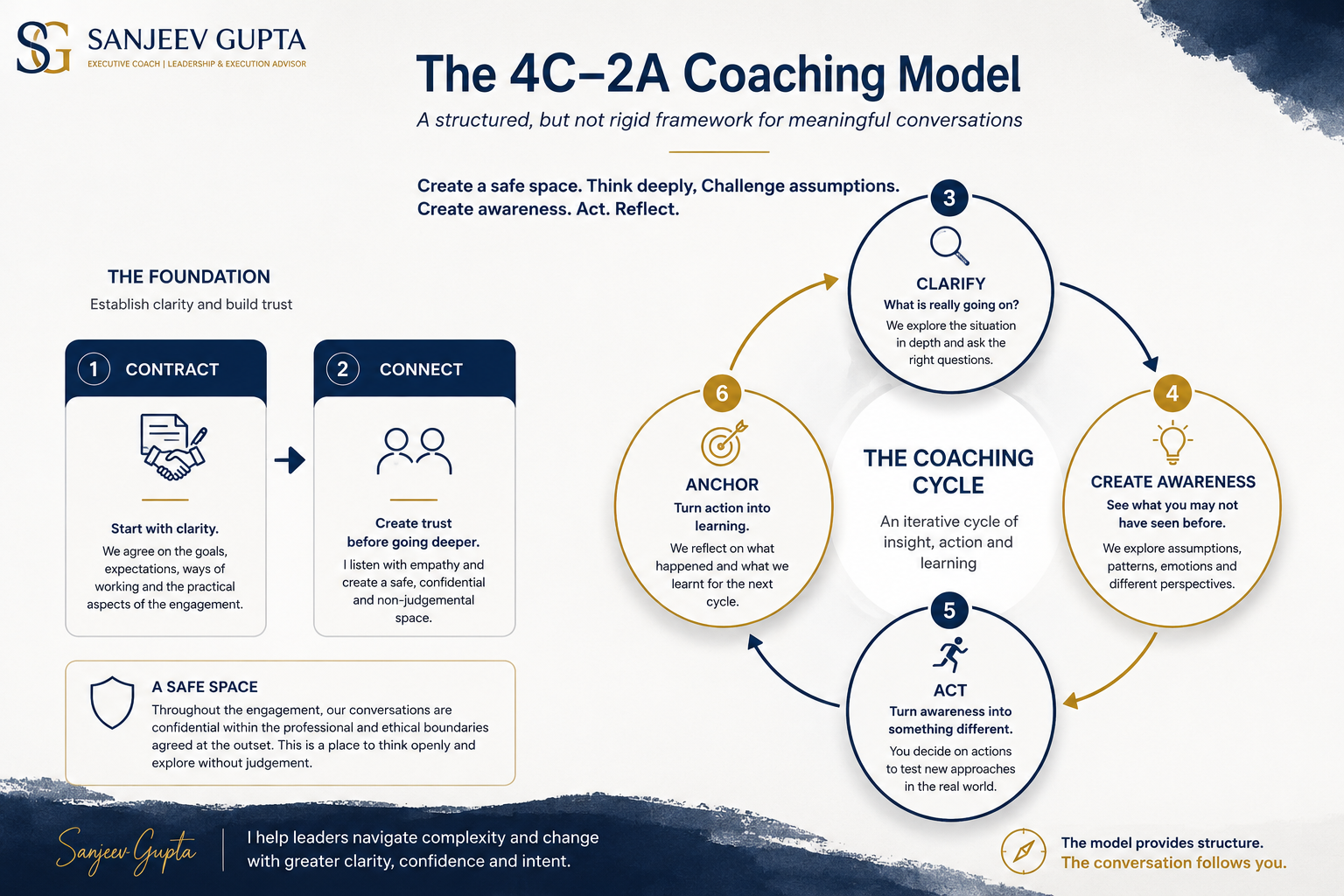
4C-2A Coaching Model Diagram
Comprehensive Breakdown

4C–2A Model in Detail

A coaching conversation does not always move neatly from one stage to the next. The structure provides direction. The conversation follows the client.

A meaningful engagement begins by understanding why we are having these conversations, what you would like to be different and what will make the engagement worthwhile. We agree the broad goals, expectations, ways of working and practical aspects of the engagement. Where coaching is sponsored by an organisation, contracting also creates clarity between the leader, sponsor and coach about the purpose and expected outcomes.
Good coaching requires openness, and openness is difficult without trust. I aim to create a safe, confidential and non-judgemental space where you can speak honestly — including about situations where you may be uncertain, uncomfortable or simply don't yet have an answer. For individuals investing in coaching themselves, Contract and Connect may naturally happen within the same initial session.
The issue we begin with is not always the issue we eventually need to work on. Clarifying means slowing down enough to understand the situation before rushing towards a solution. Sometimes a better question is more useful than a quick answer.
Greater clarity can reveal assumptions, patterns and possibilities that are difficult to notice when you are inside the situation. We may explore how you are interpreting the situation, assumptions you are making, patterns in how you respond, how others may experience your behaviour, emotions influencing your response, strengths you may not be using fully, and choices or perspectives you have not considered. Greater awareness creates greater choice.
Insight matters when it influences what happens next. That may mean making a decision, having a conversation you have been avoiding, delegating differently, responding differently under pressure, trying a new approach with your team, or taking a small step towards a larger career decision. Actions do not always need to be dramatic; small, conscious changes can create useful learning.
Sustainable change requires reflection, learning and reinforcement. Progress and commitments are revisited throughout the coaching journey — not simply to check whether an action was completed, but to understand what happened, what was learnt and what needs to change next. Sometimes this reinforces a new behaviour; sometimes it creates another question; and sometimes it takes us back into the cycle: Clarify ↔ Create Awareness ↔ Act ↔ Anchor.
Governance • Confidentiality

When an Organisation Sponsors the Engagement

Organisation-sponsored coaching needs to balance two legitimate expectations: the organisation needs clarity about why it is investing in coaching, and the leader needs confidence that coaching provides a safe and confidential space.

At the start, we agree the broad goals of the engagement and the roles of the leader, sponsor and coach. The content of individual coaching conversations remains confidential within the professional and ethical boundaries agreed at the outset.

If progress conversations with the sponsor are part of the engagement, we agree beforehand what will be shared and how the leader will participate.

Clear contracting protects both purpose and trust.

Start With a Conversation

You don't need to understand the complete 4C–2A model before we work together. The model provides structure in the background. What matters is the conversation in front of us.

Start a Conversation →